
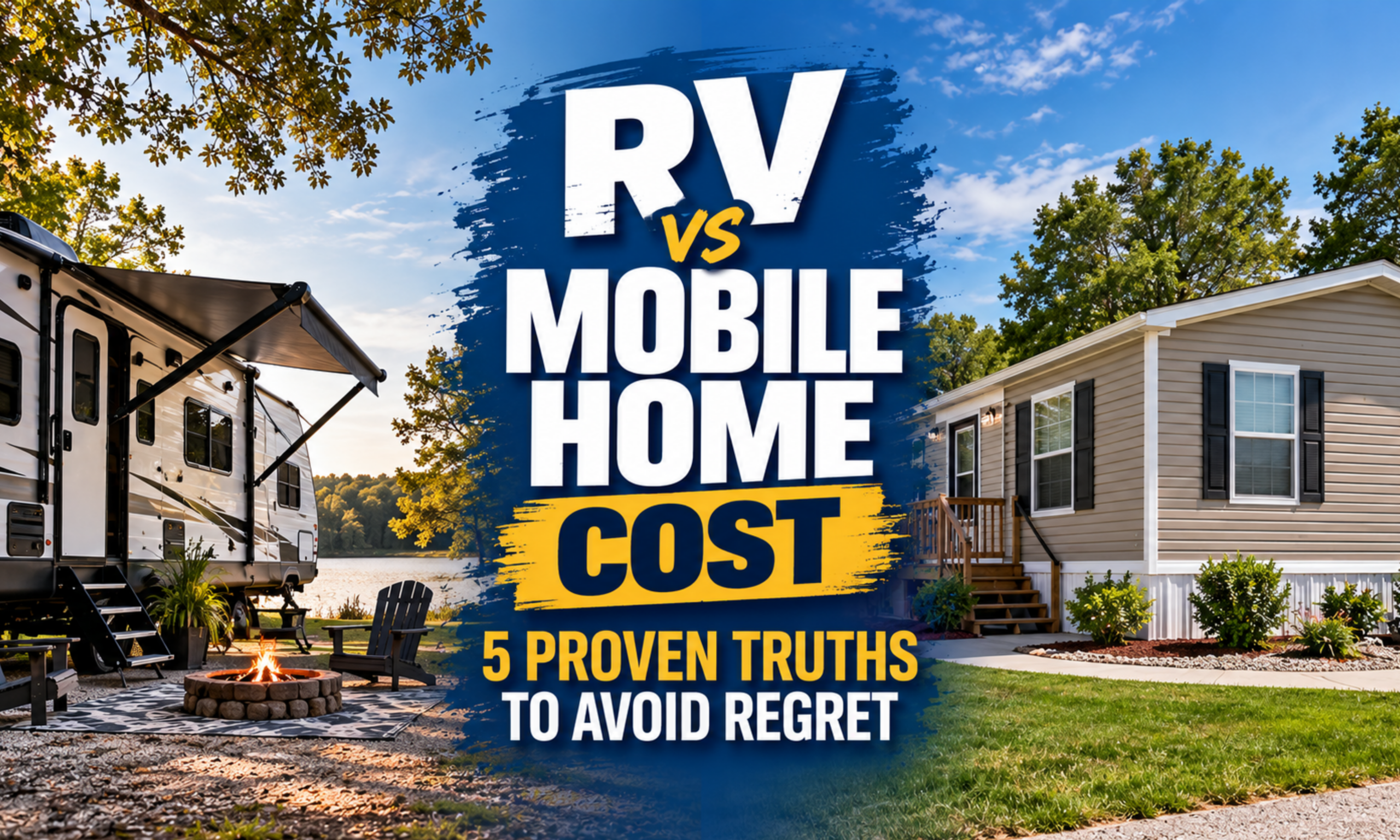
RV vs mobile home vs tiny home is the comparison most people are actually running when they start looking at RVs, even if they never say it out loud. Nobody wakes up wanting a camper. They wake up wanting out of a lease that went up again.
So you start pricing everything small. A used single wide two counties over. A tiny home build somebody posted on Facebook. A travel trailer with a bunkhouse. Three very different things, all promising the same thing: a payment you can live with and something that is yours at the end. If you have already worked through whether RV ownership is right for you, this is the next question down the list.
Here is the honest version, including the parts that never show up on a price tag.
RV vs mobile home vs tiny home, the short version
Sticker price is the least useful number of the three. What decides this is which one a lender will approve for you, which one you can legally put somewhere, and which one you can walk away from if the job moves.
Most comparisons stop at price per square foot. That is the wrong measurement for someone who needs housing sorted out in the next sixty days. Five things matter more in an RV vs mobile home decision, and they are the five this post walks through.
Truth 1. In RV vs mobile home math, the sticker price is the least important number
All three of these can carry similar price tags and still land in completely different places on your monthly budget, because the price tag is only the part you see.
A manufactured home has to get to the lot before you sleep in it. That means delivery, blocking, anchoring, skirting, utility hookups and permits, handled by a licensed installer. All of that is due before move in, and none of it is in the advertised price.
A tiny home is usually a custom build. Custom means the cost per square foot often runs higher than a comparable RV, not lower, because you are paying for one off labor instead of a factory line that has built the same floorplan three thousand times.
An RV rolls off the lot finished. Hook it up, level it, and you are living in it. That gap in time is also a gap in money, and it is the part the RV vs mobile home comparison usually skips.
| RV | Manufactured home | Tiny home | |
|---|---|---|---|
| Money down | $3,000 to $7,000 at RV Depot | $5,000 to $16,000 | $7,000 to $14,000 |
| Setup before move in | Hook up and level | Delivery, blocking, anchoring, skirting, utilities, permits | Depends on wheels or foundation |
| How it is titled | Titled as a vehicle | Statement of Ownership through the state | Usually titled as an RV if it is on wheels |
| How it gets financed | Vehicle loan, in house financing available | Chattel loan on leased land, mortgage only if attached to land you own | Hardest of the three, often an RV loan or a personal loan |
| Where it can go | RV parks, some private land, subject to park age rules | A mobile home park lot lease, or land you own | Most RV parks want RVIA certification, many cities block them on foundations |
| Can you move it later | Yes, whenever you want | Rarely, and it is expensive | On wheels yes, on a foundation no |
| Time to move in | Days | Weeks to months | Weeks to months |
Look at the top row before anything else. The RV has both the lowest starting point and the lowest ceiling of the three, and it is the only one of them you can be living in within days rather than months. That gap is the whole RV vs mobile home argument for a family that needs housing handled now.

Truth 2. In RV vs mobile home terms, where you can legally put it decides more than what it costs
The cheapest option you cannot park is not an option. This is where most of these comparisons fall apart in real life.
- An RV goes in an RV park, and in some places on private land, subject to park rules and county rules. The one that catches people is the age rule: plenty of parks will not take a unit older than ten years, which quietly rules out the cheapest listings you are looking at.
- A manufactured home goes on a leased lot in a mobile home park, or on land you own. Either way it has to meet state installation requirements, and it is not going anywhere afterward without a serious bill.
- A tiny home is the hardest of the three to place. On wheels, it is usually classified as an RV, and most RV parks want to see RVIA certification before they will take it. On a foundation, minimum square footage rules in a lot of cities will not allow it at all.
Before you fall for any of the three, find out where it is going. Call two parks. Ask about age limits, certification and whether they have monthly spots open at all. An RV vs mobile home comparison done from the couch is guesswork until somebody confirms they have a spot for it.

Truth 3. RV vs mobile home financing is a completely different animal
This is the part that decides it for most hardworking families, and it has nothing to do with which one is nicer.
A manufactured home sitting on a leased lot is personal property, not real estate. That means a chattel loan, which generally carries a higher rate and a shorter term than a mortgage. To get an actual mortgage on one, it usually has to be permanently attached to land that you own, which means you need the land first.
A tiny home is harder still. Most banks will not write a mortgage on a home with a hitch. If it is RVIA certified you may be able to finance it like an RV. If it is not, you are often looking at a personal loan, which is the most expensive money in this comparison.
An RV is titled as a vehicle and financed as one, which is why the RV vs mobile home question so often ends right here. At RV Depot, in house financing means the decision is made in house, there are no minimum credit score requirements, and the focus is on your income and stability instead of what happened three years ago. Down payments generally run $3,000 to $7,000 and terms run five to eight years.
That is the real question underneath all of this. Not which one is cheapest on paper, but which one somebody will actually approve while you are still rebuilding.
Truth 4. Only one of the three can leave with you
This is the RV vs mobile home difference nobody puts a price on. Moving a manufactured home is a major expense, and plenty of them are never moved again after the day they are installed. Whatever you save on the purchase, you pay back in flexibility. That home ties you to that lot, that park and that local job market.
A tiny home on wheels can move, but it is heavy, and towing one usually asks more of a tow vehicle than a comparable travel trailer does. A tiny home on a foundation does not move at all.
An RV goes where you go. A job relocation, a better park, a cheaper lot forty minutes away, a move closer to family. For anyone in the trades, anyone chasing overtime, or anyone whose work has moved them before, that is not a lifestyle perk. It is the whole point.
You are not just buying somewhere to live. You are buying how hard it will be to leave.

Truth 5. RV vs mobile home resale value, honestly
Nobody in this comparison is buying an appreciating asset, and anyone telling you otherwise is selling something.
A manufactured home on a leased lot is personal property and generally loses value the way a vehicle does. On land you own, permanently attached, it can hold value better, but that is a different purchase with a different price tag, because now you are buying land too.
A tiny home has a small resale market. Custom means custom, and the person who wants your exact build may take a while to show up.
An RV depreciates, and you should go in knowing that. What you are actually buying is a lower monthly housing cost and a payment with an end date on it. Rent has neither.
RV vs mobile home: which is the cheapest honest path to owning?
It depends on one question: what does the next five years look like?
- You already own land and you are staying put for the long haul. Price a manufactured home. On your own land, permanently attached, it is the strongest of the three.
- You want small and custom, and you have cash or strong credit. A tiny home can be a good fit. Sort out where it is going before you order it.
- You need housing handled soon, you need financing that looks at income, and work might move you. That is an RV, and it is not a compromise. It is the option built for that situation.
Most of the families who run the RV vs mobile home comparison and end up talking to us land in that third group. Not because an RV beats everything on a spreadsheet, but because it is the one they can be approved for, park by the end of the month, and take with them if the work moves.

RV vs mobile home questions we hear every week
Is an RV cheaper than a mobile home?
Often, once you count setup. A manufactured home carries delivery, installation and permit costs before you move in. An RV is ready when you hook it up. Compare the total cost to be living in it, not the advertised price.
Can you live in an RV full time in Texas?
Yes, and a lot of families do. Where you park it is governed by the park’s rules, and by county rules if you are on private land, so confirm both before you buy. Start with our guide to RV parks for full time living and the benefits of full time RV living.
Can I put a tiny home in an RV park?
Usually only if it is RVIA certified. Many parks will not take an uncertified build, which is the detail that catches tiny home buyers after the money is already spent.
What is the real difference in RV vs mobile home monthly cost?
Once both are parked, the monthly side looks similar: a payment, lot rent, utilities and insurance. The RV vs mobile home gap shows up before that, in setup costs, and after that, in what it costs you to leave.
Does a mobile home hold value better than an RV?
On land you own and permanently attached, generally yes. On a leased lot as personal property, it depreciates much the way an RV does. We took that question on directly in is buying an RV a good investment.
Which one is easiest to finance if my credit is still rebuilding?
The RV, in most cases. In house financing at RV Depot has no minimum credit score requirements and weighs income and stability instead. Chattel loans and personal loans tend to be stricter, more expensive, or both.

Come tell us what you are actually trying to solve
RV Depot began with a simple mission: help more families find a realistic path to RV ownership. What started as a local operation in Cleburne grew into The RV Dealership That Says YES for buyers across Texas and beyond, built on real people, real support and financing solutions designed around real-life situations.
We know everyone’s story is different. Maybe you’re starting over. Maybe you’re chasing a dream of living off-grid. Maybe you’re downsizing and simplifying. Whatever your reason for hitting the road, we make that path accessible, no judgment, just solutions. We listen, we work with you rather than your credit score, and we cheer for your wins.
Come see what that looks like in person. There are more than 400 RVs on over 20 acres in Cleburne, which means the conversation starts with what fits your budget instead of with whatever happens to be sitting on the lot that week.
Come visit us at 4319 N. Main St in Cleburne. We’d love to meet you and help you start your journey.
All credit welcome. In house financing available. Down payment amounts vary by unit and by individual situation.
FOLLOW US ON SOCIAL MEDIA


