

Construction worker housing comes down to three choices on most projects, and nobody lays them out side by side before you have to pick one. Company housing, a hotel, or something you own and tow. Here is the honest version of all three, including where an RV is the wrong answer.
You already know the lines. Company housing wears thin fast. You are too old for roommates. You are done handing a hotel another four thousand this month. You want to keep your per diem instead of giving it back. And somewhere under all of it, you miss your wife and kids.
None of that is a housing preference. It is the same complaint from three different angles: you have no control over where you sleep, and it is costing you money you were supposed to keep. That is really what the construction worker housing question comes down to on a long assignment.
Company housing and a hotel both disappear the day the project wraps, and you have nothing to show for either. The third one follows you to the next job and keeps its value while it does.
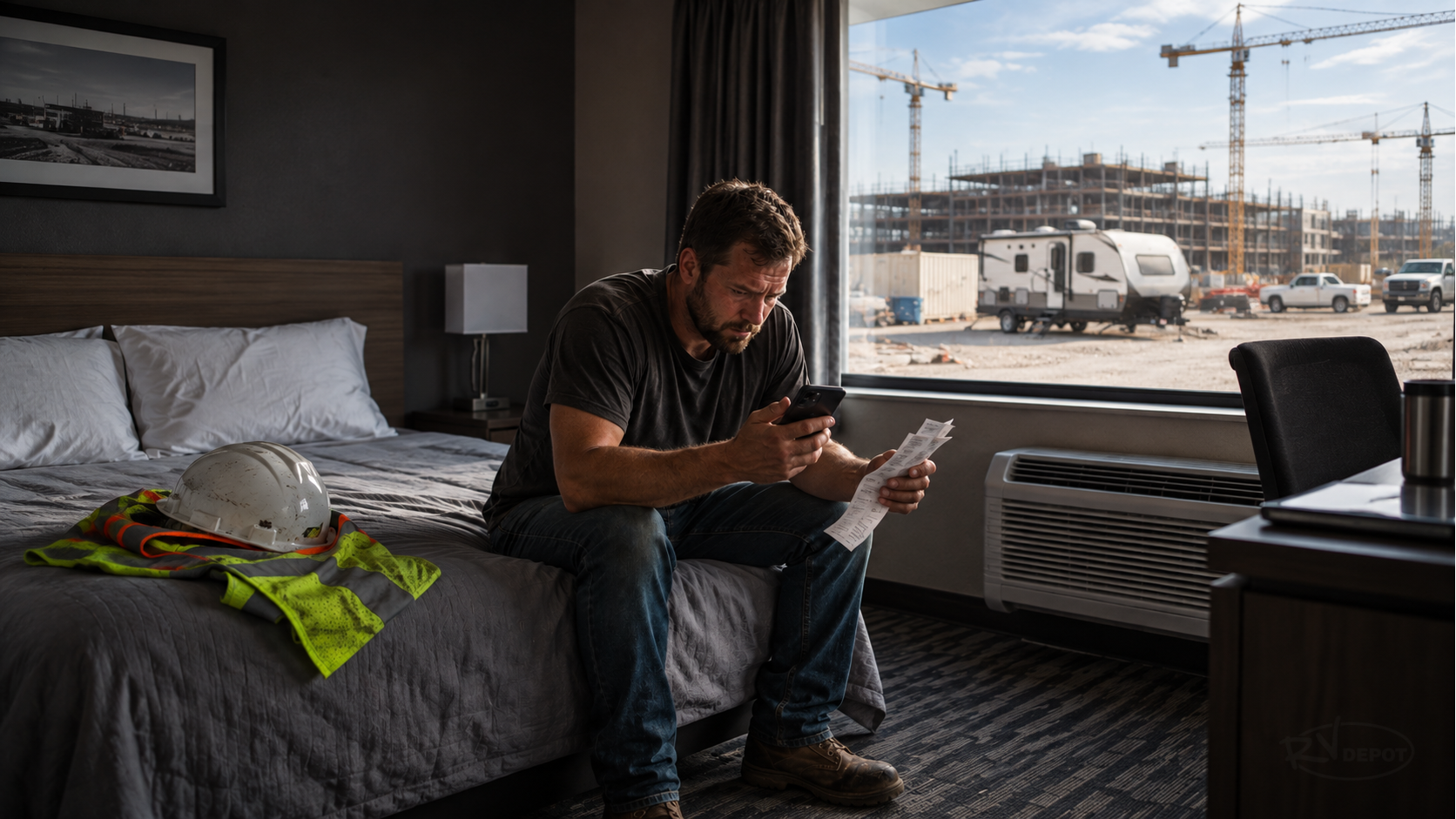
Construction worker housing, compared straight
| Company housing | Hotel | Your own RV | |
|---|---|---|---|
| Who picks it | The company | The company, usually | You |
| Roommates | Often | Sometimes on a shared rate | Never, unless you want them |
| Your per diem | Reduced or gone | Gone | Yours to keep or spend |
| Privacy | Low | Medium | Yours |
| Family can stay | Rarely | Expensive and cramped | Yes |
| Pets | Usually no | Fees, if allowed at all | Yes |
| Cooking | Depends on the setup | A microwave, if you are lucky | A real kitchen |
| When the project moves | Starts over | Starts over | Comes with you |
| At the end of the job | You own nothing | You own nothing | You own the RV |
Construction worker housing option 1: company housing
The pitch is that it is free, or close to it. That is why it is the construction worker housing most crews start with, and the part nobody says out loud is what you trade for it.
You do not pick the place, the roommates, the distance from the site, or the rules. If it is a man camp setup, you are sharing walls with guys running the opposite shift. If it is a block of apartments, you are still living out of a duffel bag in somebody else’s furniture. Either way it usually reduces or eliminates your per diem, which means the housing was never free. It came out of the same pot.
And it ends the day the job does. There is no version of company housing where you walk away with anything.
For a six week outage it is fine, and honestly it is the right construction worker housing for that length of job. Nobody buys an RV for six weeks. For a twelve month build with your family three hundred miles away, it is a long time to live somewhere you had no say in.
Construction worker housing option 2: hotels, which eat the most
Hotels are the default because they are easy to book and easy to expense. They are also the most expensive construction worker housing ever invented for anyone on a long project.
Crews on long assignments routinely talk about $3,000 to $5,000 a month going to lodging. Over a twelve month project that is the price of a decent used travel trailer, spent, gone, with a stack of folios and nothing else to show for it.
The quality of life side is worse than the math. A mini fridge instead of a kitchen. Housekeeping in your room while you are trying to sleep off a night shift. Nowhere to put tools. Nowhere for your wife and kids to be for a week without paying for a second room. And every few weeks, depending on availability, you move.
Construction worker housing option 3: your own RV, honestly
This is the one this whole comparison is usually pointed at, so let us be straight about both sides of it. An RV is the only construction worker housing on this list that you own rather than occupy, and that cuts in both directions.
What you get: your own bed, your own kitchen, your own bathroom, no roommates, no housekeeping, and a place your family can come stay without a second hotel room. You keep whatever is left of your per diem after a park spot, which is usually a lot. When the project moves, your housing moves with it. When the project ends, you own something.
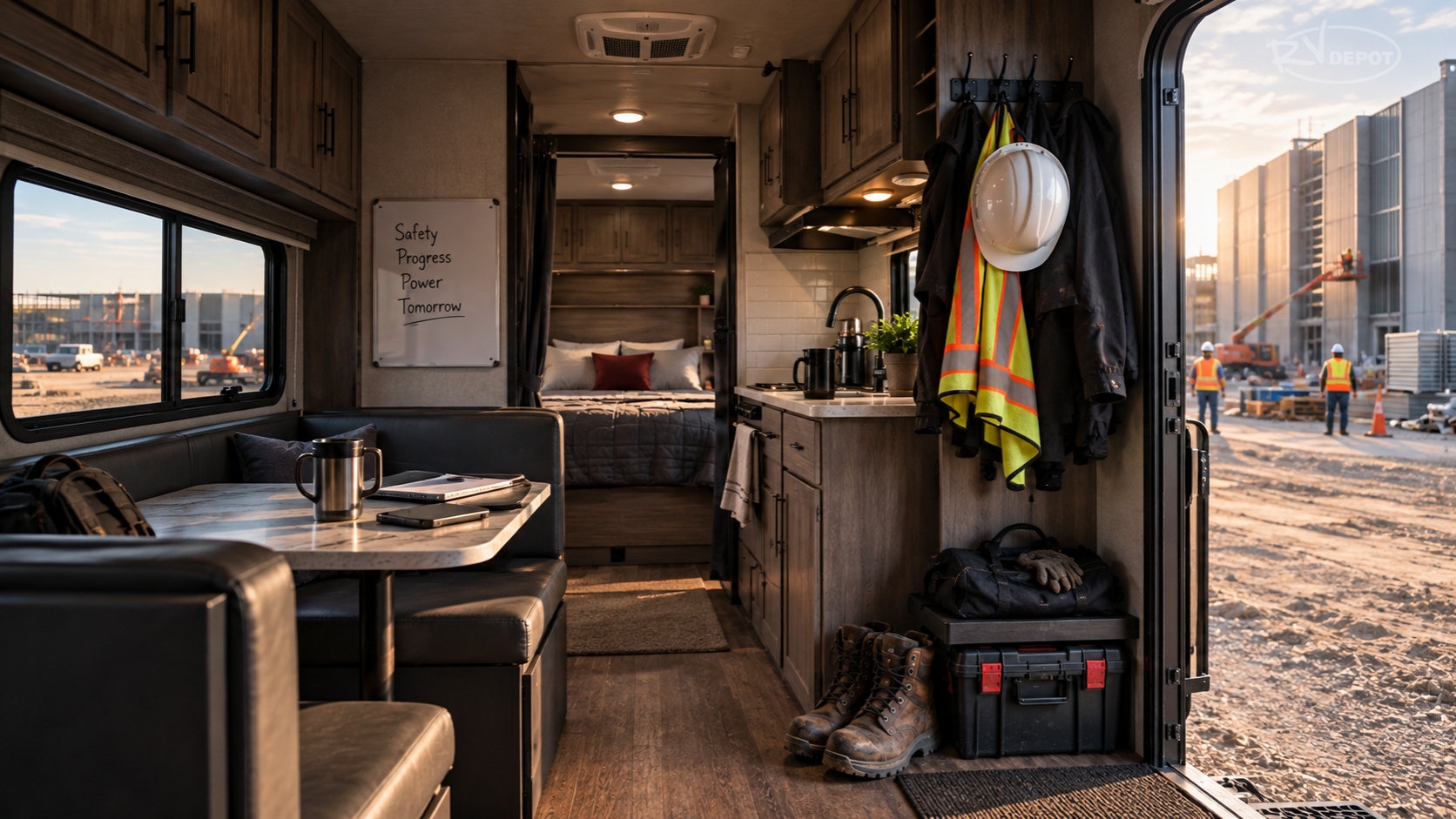
What it asks of you: a tow vehicle and the ability to use it, a park that will take your unit, basic maintenance you either learn or pay for, and the discipline to handle a payment in a trade where income is not perfectly even month to month. It is a purchase, not a booking. That is the whole difference, in both directions.

When an RV is the wrong construction worker housing choice
We sell RVs and we will still tell you when it is not the move. Four situations where it is not:
- Short assignments only. If your jobs run four to eight weeks and then you are home for a month, the math rarely works. Buy for the pattern you actually work, not the one big project in front of you.
- No tow vehicle and no plan to get one. A travel trailer without something rated to pull it is a parked building. Sort the truck question before the RV question.
- You genuinely do not want to maintain anything. Roofs get sealed, tires age out, things rattle loose on the highway. If that sounds like a burden rather than a Saturday, a hotel may actually suit you better.
- Your work never repeats in the same region. If you are on a different coast every quarter, the towing costs start eating the savings.
If none of those describe you, and your projects run six months or longer in a region you keep coming back to, the construction worker housing comparison stops being close.
Where does this kind of construction worker housing actually park
This is the question that stops most buyers, and it is a fair one. The answer is monthly spots at RV parks near the work, and it is a well worn path. Traveling trades are a big share of who fills long term parks, which means this version of construction worker housing is far more common than it looks from a hotel lobby.
The one thing to sort out before you buy: many parks will not accept a unit older than ten years. Call two parks near your site, ask the age limit, and shop inside it. That single phone call is the difference between owning something you can park and owning something you cannot.
The construction worker housing question nobody in this trade likes
Here is the part that decides the construction worker housing question for a lot of people, and it has nothing to do with which option is nicer.
The money in this work is good. The year to year is not even. Overtime years and shutdown years look nothing like the year you spent between projects, and plenty of people clearing six figures on a build still have credit carrying damage from a divorce, a layoff, or a stretch with no work. Banks read that as risk. It is not risk. It is this industry.
At RV Depot the decision is made in house. There are no minimum credit score requirements, and the focus is on your income and your stability rather than a number from three years ago. We work with 1099 income, cash earnings, seasonal patterns and multiple income sources, because that is what walks through the door. Down payments generally run $3,000 to $7,000, terms run five to eight years, and every towable financed in house comes with a six month warranty at no extra cost.
There are over 400 RVs on more than 20 acres in Cleburne, which means the conversation starts with your park’s age limit and the payment you want rather than with whatever happened to land on the lot.
Construction worker housing questions we hear on the lot
Is an RV really cheaper than the hotel my company is paying for?
It depends entirely on how your per diem is structured. If the company pays the hotel directly and your per diem is untouched, the money case is weaker and the construction worker housing decision becomes a quality of life one instead. If the lodging comes out of your per diem, the gap is usually large and it grows every month you are out.
What happens to the RV between projects?
Most owners either take it home, leave it at a park on a monthly rate, or put it in storage. It is worth pricing all three before you buy, because the answer changes what size unit makes sense, and it is the one construction worker housing cost people forget to plan for.
Can my family come stay with me?
That is the reason a lot of crews make the switch. A bunkhouse floorplan turns a solo assignment into something your kids can visit for a week of summer. Pets too, which company housing almost never allows. We covered that side in RV living with pets.
What about my mail and my address while I am out?
Solvable, and worth setting up before you go rather than after. We walked through the options in full time RV living and your mailing address.
Do other trades do this, or is it just construction?
Travel nurses have been doing it for years for the same reasons, and the math is nearly identical. We wrote that one up in the travel nurse RV solution.
What if I have never owned an RV before?
Most of the crews we sell to had not either. Bring your park’s age limit, your monthly number and an honest picture of your income, and the rest is a conversation. Start with the benefits of full time RV living if you want the long version first.

Keep more of what you earn out there
RV Depot began with a simple mission: help more families find a realistic path to RV ownership. What started as a local operation in Cleburne grew into The RV Dealership That Says YES for buyers across Texas and beyond, built on real people, real support and financing solutions designed around real-life situations.
We know everyone’s story is different. Maybe you’re starting over. Maybe you’re chasing a dream of living off-grid. Maybe you’re downsizing and simplifying. Whatever your reason for hitting the road, we make that path accessible, no judgment, just solutions. We listen, we work with you rather than your credit score, and we cheer for your wins.
Come see what that looks like in person. There are more than 400 RVs on over 20 acres in Cleburne, an easy run from most of the Metroplex, and we will tell you straight if an RV is not the right call for the way you work.
Come visit us at 4319 N. Main St in Cleburne. We’d love to meet you and help you start your journey.
All credit welcome. In house financing available. Down payment amounts vary by unit and by individual situation. Per diem and lodging arrangements vary by employer and by contract, so confirm yours before you plan around it.
FOLLOW US ON SOCIAL MEDIA


